04 · Loyalty & growth · 2022 to 2023
Buddies by Blue Buffalo
As the first in-house design lead, I turned a forgettable rewards utility into a daily habit, grew active users from 210K to 810K, and helped it win a Gold Stevie.
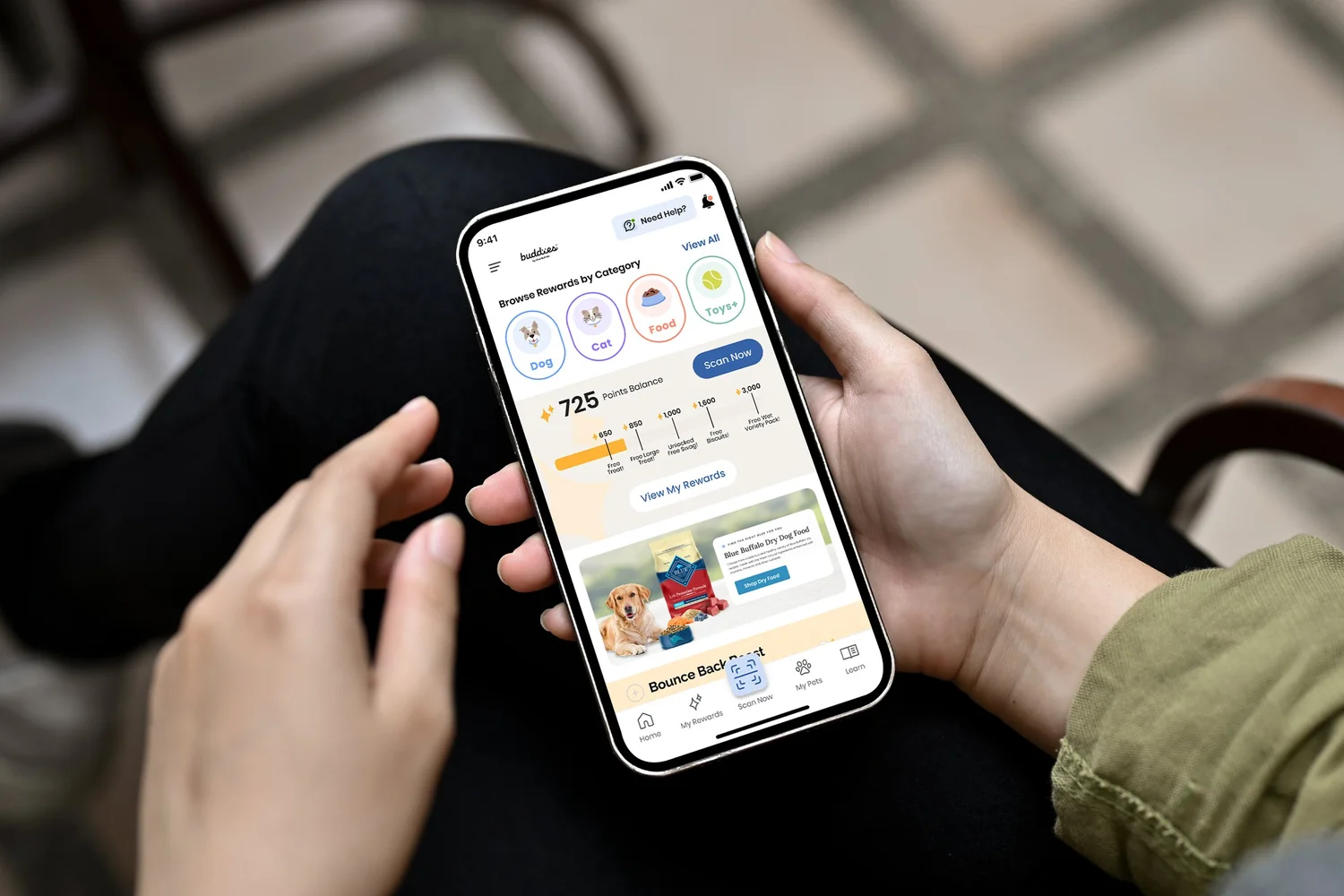
A loyalty app most people forgot they had.
Buddies rewards pet parents for buying Blue Buffalo food. When I joined as the first in-house Design Lead, it worked, but it was a transactional utility people opened, used once, and forgot.
I led the product design end to end and rebuilt the experience around the one loop that creates value: earn a reward, feel rewarded, come back. I owned strategy, information architecture, interaction and visual design, prototyping, and usability testing, and I built the design system and mentored a team of three other designers so we could ship quickly without losing quality.
The redesign nearly quadrupled active users, lifted store ratings to near the top of the category, and earned the team a 2023 Gold Stevie Award and recognition from Loyalty360.
210K→810KMonthly active users
4.7→4.9App Store rating
89%Receipt-scan completion
73%Higher 30-day retention
40%Fewer support tickets
Gold2023 Stevie Award
The value was real. The habit was not.
Blue Buffalo had a loyal customer base and a generous rewards program, but the app that delivered it was underused. People signed up, claimed a reward, and drifted away. Engagement was flat and the team had little visibility into why.
The most telling number came out of early research: 42% of users did not know the receipt and QR rewards existed at all. The core value of the product was effectively hidden. That reframed the project for me. This was not a visual refresh. It was a behavior-change problem, and the job was to make earning feel obvious, instant, and worth coming back for.
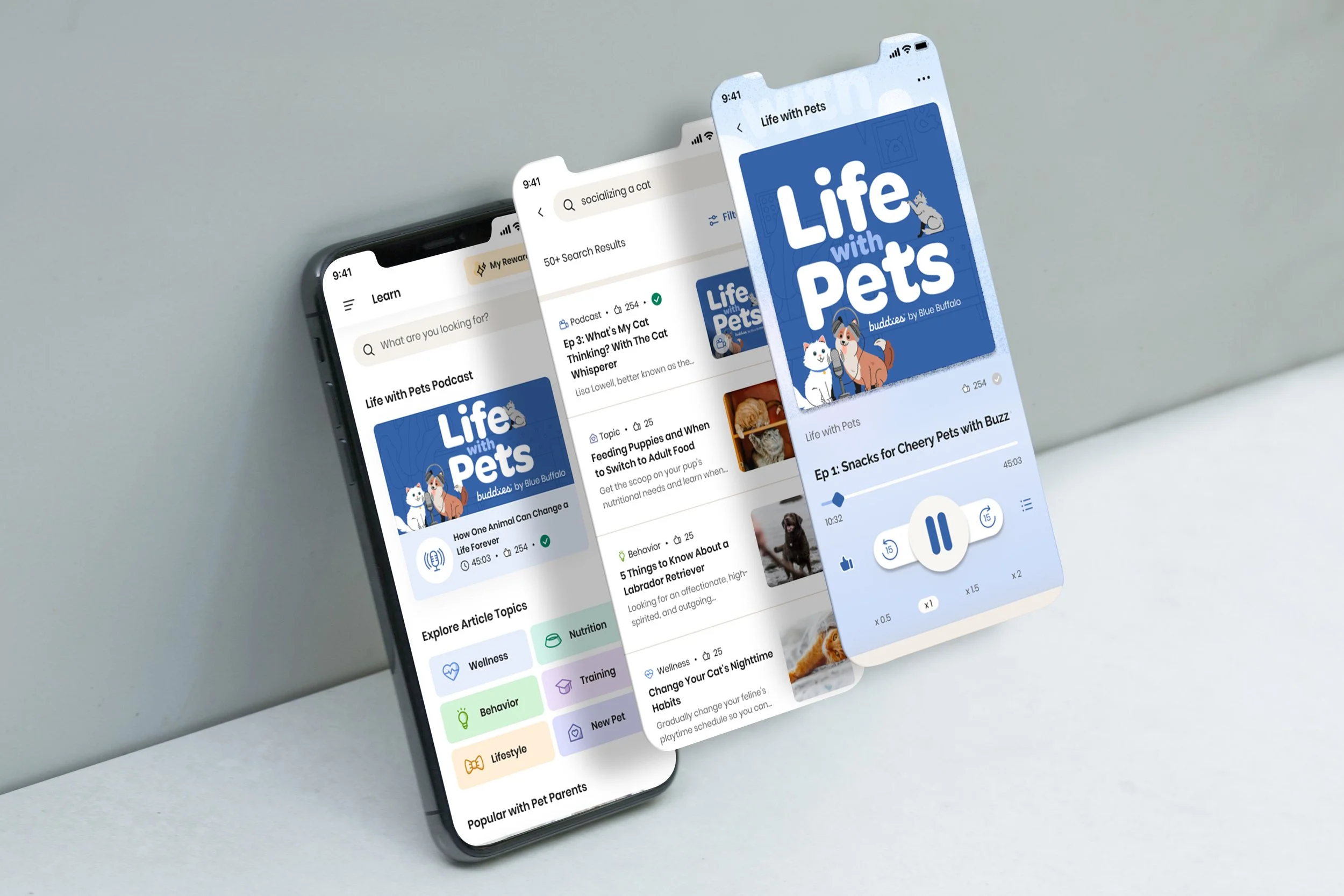
A pile-up of friction around the one flow that mattered.
Earning a reward meant proving a purchase, almost always by scanning a paper receipt. That flow was the heart of the product, and it was also where people gave up most. Around it sat a set of compounding constraints:
A brutal single-screen scan. Capture, crop, and submit happened on one dense screen. 34% of attempts were abandoned before completion.
Hidden value. 42% of users did not know receipt or QR rewards existed, so they never reached the flow at all.
Coupon-book tone. The app felt transactional, not like a companion for a pet parent who loves their dog.
Thin analytics. We could see drop-off but not the why, so every decision risked being an opinion.
OCR you do not control. Receipt reading ran on a third-party engine (Microblink) with its own error modes and latency.
A small team, a big surface. Four designers across iOS and Android needed to move fast and stay consistent.
The challenge
Turn a forgettable rewards utility into a daily habit pet parents look forward to, without adding a single point of friction to the one flow that matters most: getting credit for a purchase.
Three rules I designed against.
To keep a small team aligned and decisions defensible, I set three principles up front. Every major call traces back to one of them.
01
Reward the moment
Earning should feel instant and unmistakable. The payoff has to land the second the work is done.
02
Companion, not coupon book
Speak to a pet parent, not a shopper. Warmth and the pet come first, the transaction second.
03
One thing at a time
In the flows that matter, show the single next action. Reduce what is on screen to reduce error.
Growth backed by evidence, not hope.
I ran a mixed-method program so the roadmap was grounded in behavior, not guesses. I mined thousands of store reviews for recurring language, ran interviews with pet parents across the loyalty spectrum, and worked with analytics to map the real earn funnel end to end.
Triangulating those sources produced a clear, shared picture of who we were building for and where the loop broke. I translated that into three decision-making personas and a reprioritized roadmap that put the earn loop, not new features, at the center.
Key insight
People were not bored of the rewards. Most never found them. Discovery, not generosity, was the lever.
That insight changed where the team spent its energy. Instead of adding reward types, we invested in surfacing the ones we already had and in making the act of earning effortless.
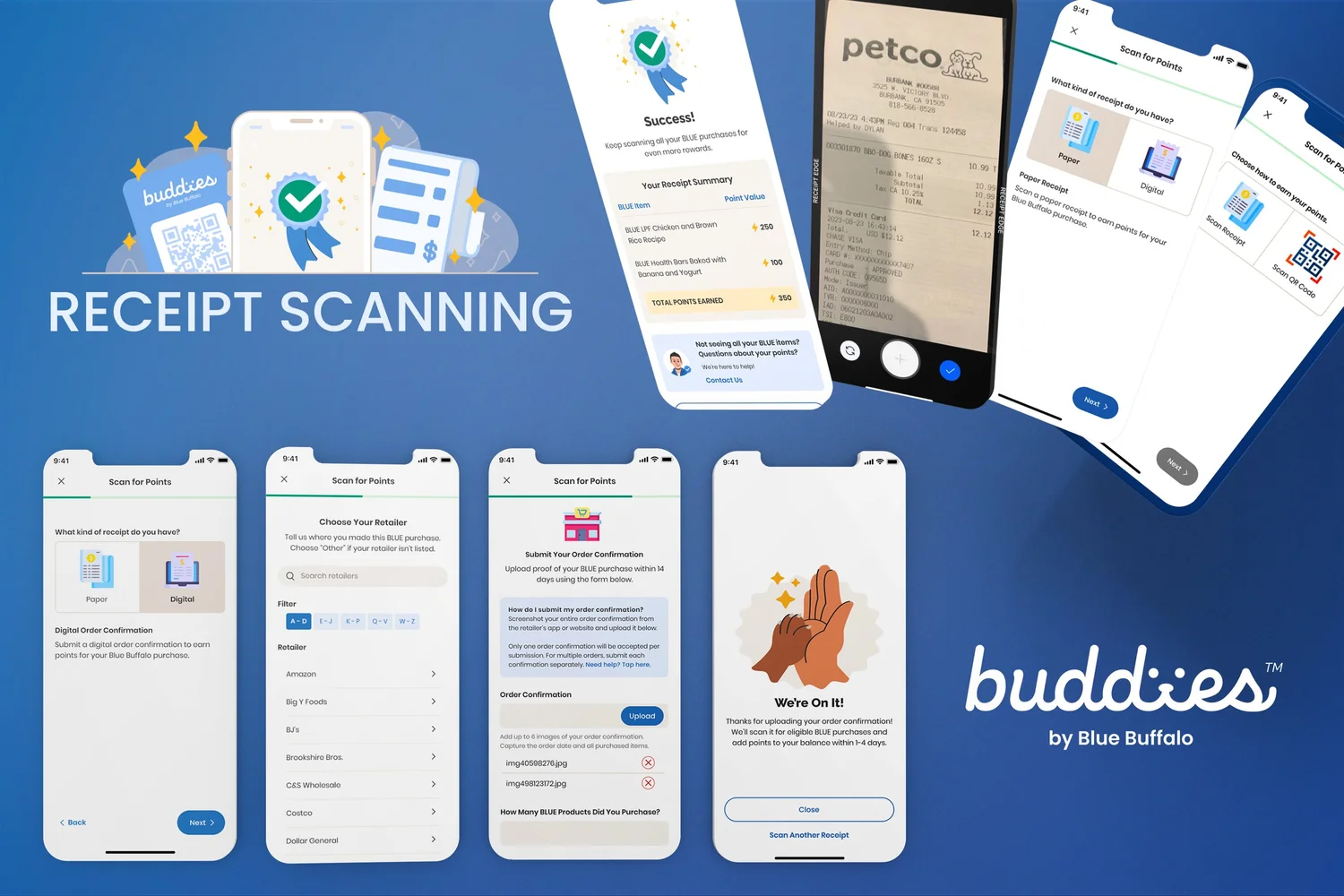
Receipt scanning, rebuilt end to end.
The single-screen scan was the highest-leverage fix in the product. It asked people to capture, align, crop, and submit a photo of a paper receipt all at once, then wait on an OCR engine that sometimes failed silently. A third of attempts never finished.
I prototyped two directions and tested them against each other with real receipts and real users.
Option A · Single screen
Everything at once
- Fewer taps in the happy path
- Familiar to existing users
- No room to recover from a bad capture
- No feedback while OCR runs, so people assumed it broke
- 34% abandonment
Option B · Guided wizard · chosen
Capture, confirm, reward
- One decision per step, low cognitive load
- A confirm step to catch bad scans before submit
- Live progress while OCR runs, then an instant reward moment
- One extra screen in the happy path
The extra step looked like added friction on paper, but in practice it removed the anxiety that was actually causing drop-off. Splitting the flow into capture, confirm, and reward let me design honest feedback for the Microblink OCR step, so people knew their receipt was being read rather than wondering if the app had frozen.
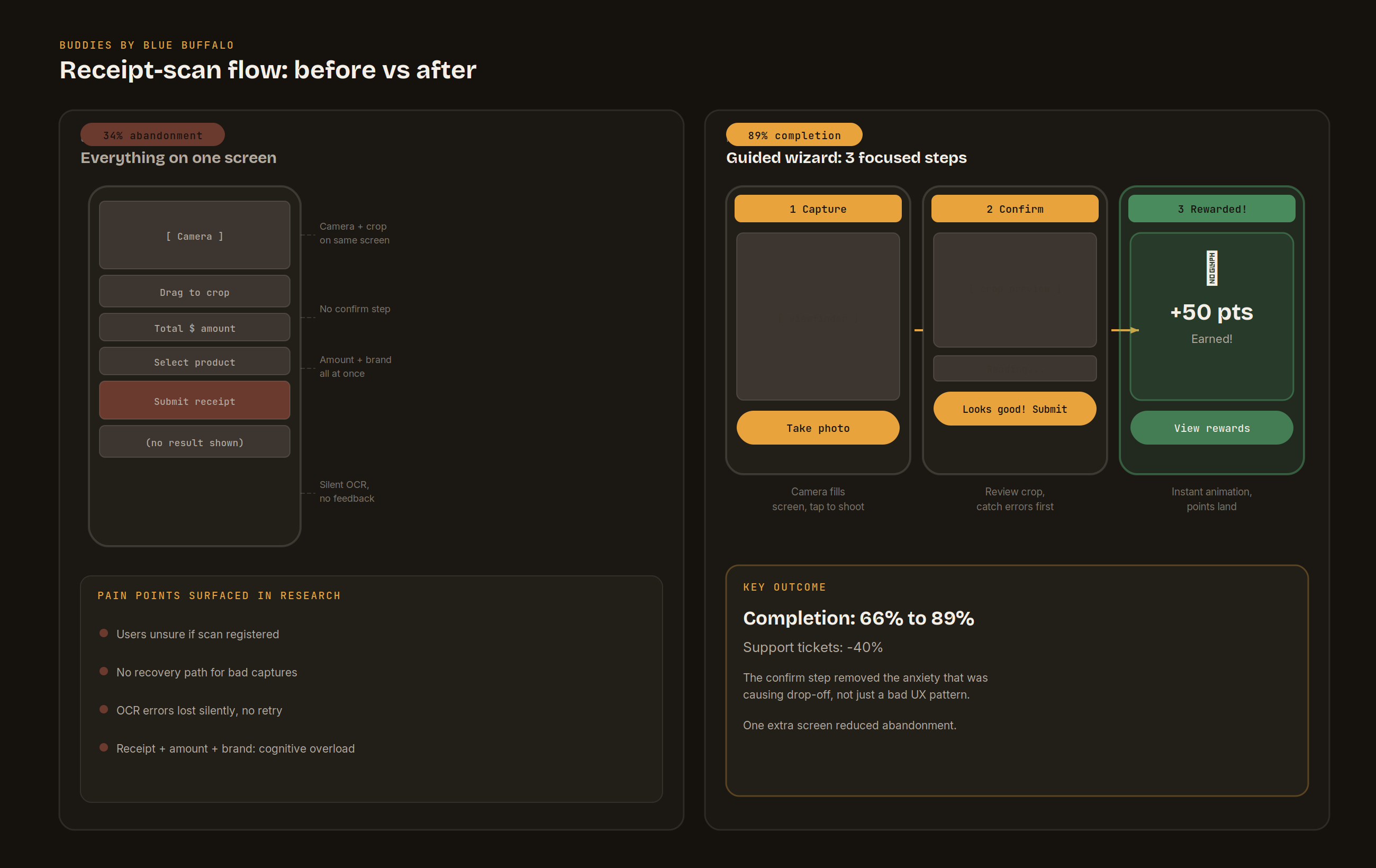
The breakthrough
Pairing the confirm step with an instant, animated reward moment took receipt-scan completion from 66% to 89%, and cut support tickets about "missing points" by 40%.
Putting the reward where people already look.
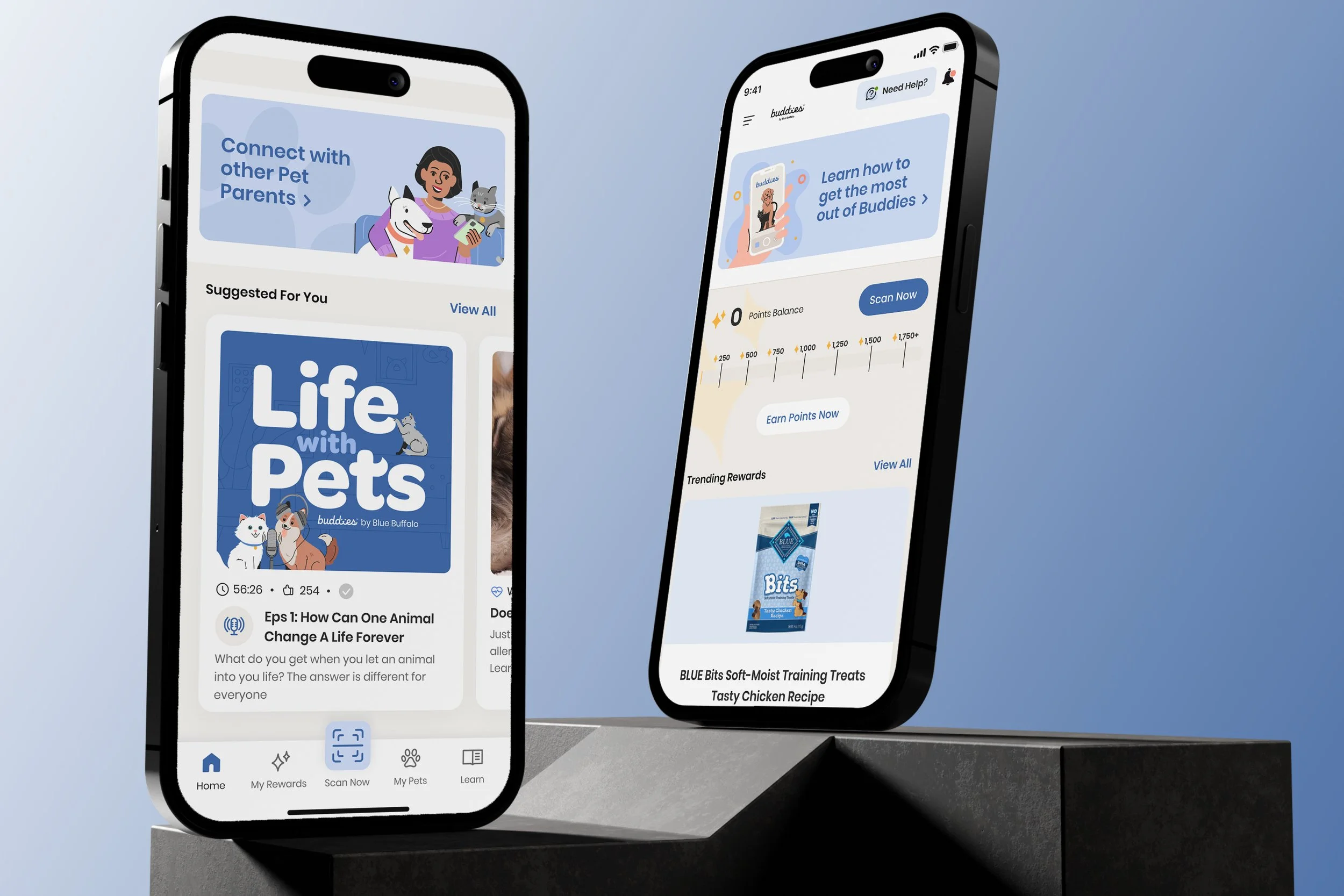
Fixing the flow only helps people who reach it. To solve the 42% who never found rewards, I rebuilt the home experience around the earn loop. Earning moved to the first thing you see, progress became visible and motivating, and rewards surfaced contextually instead of hiding behind a menu.
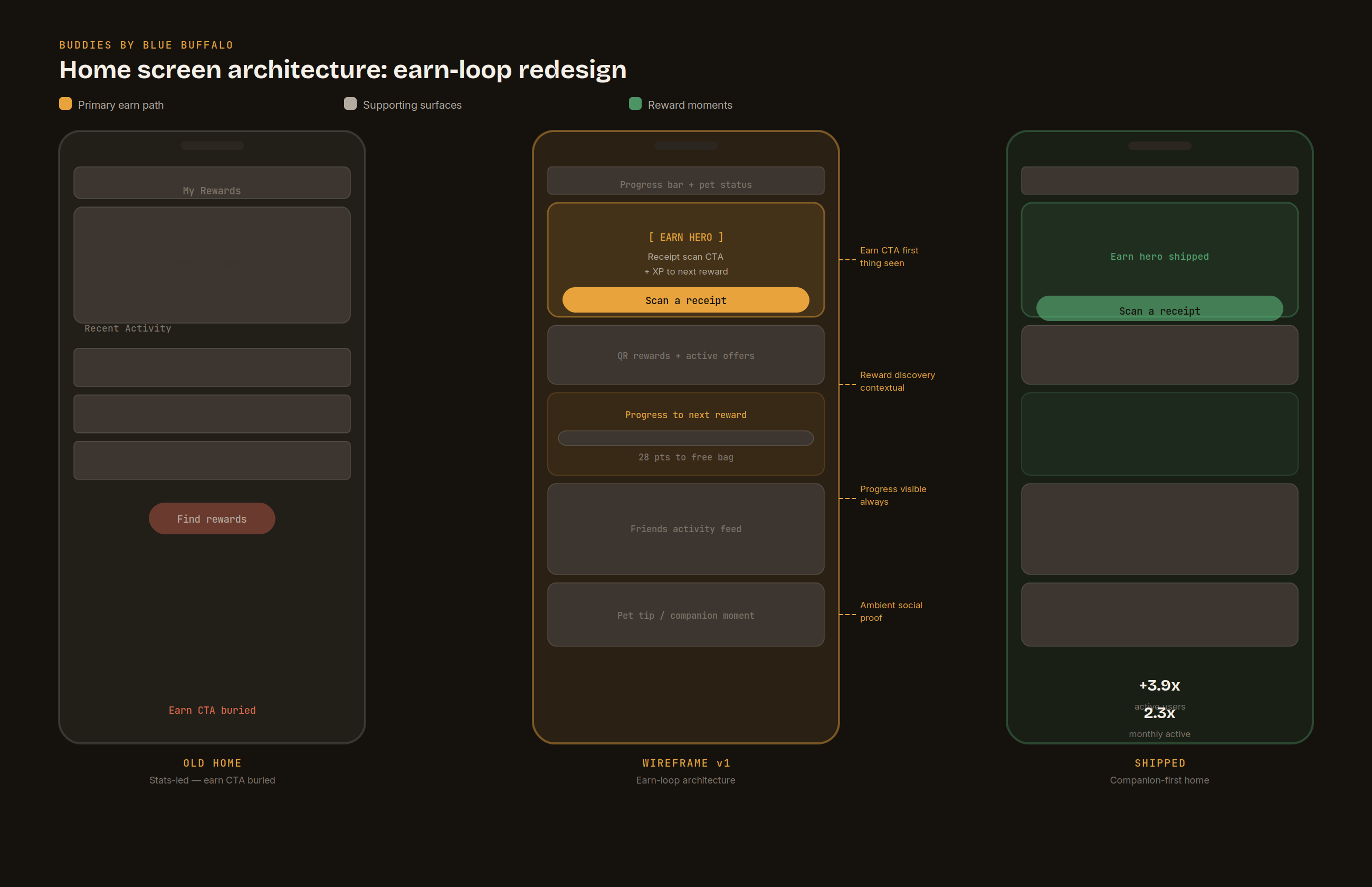
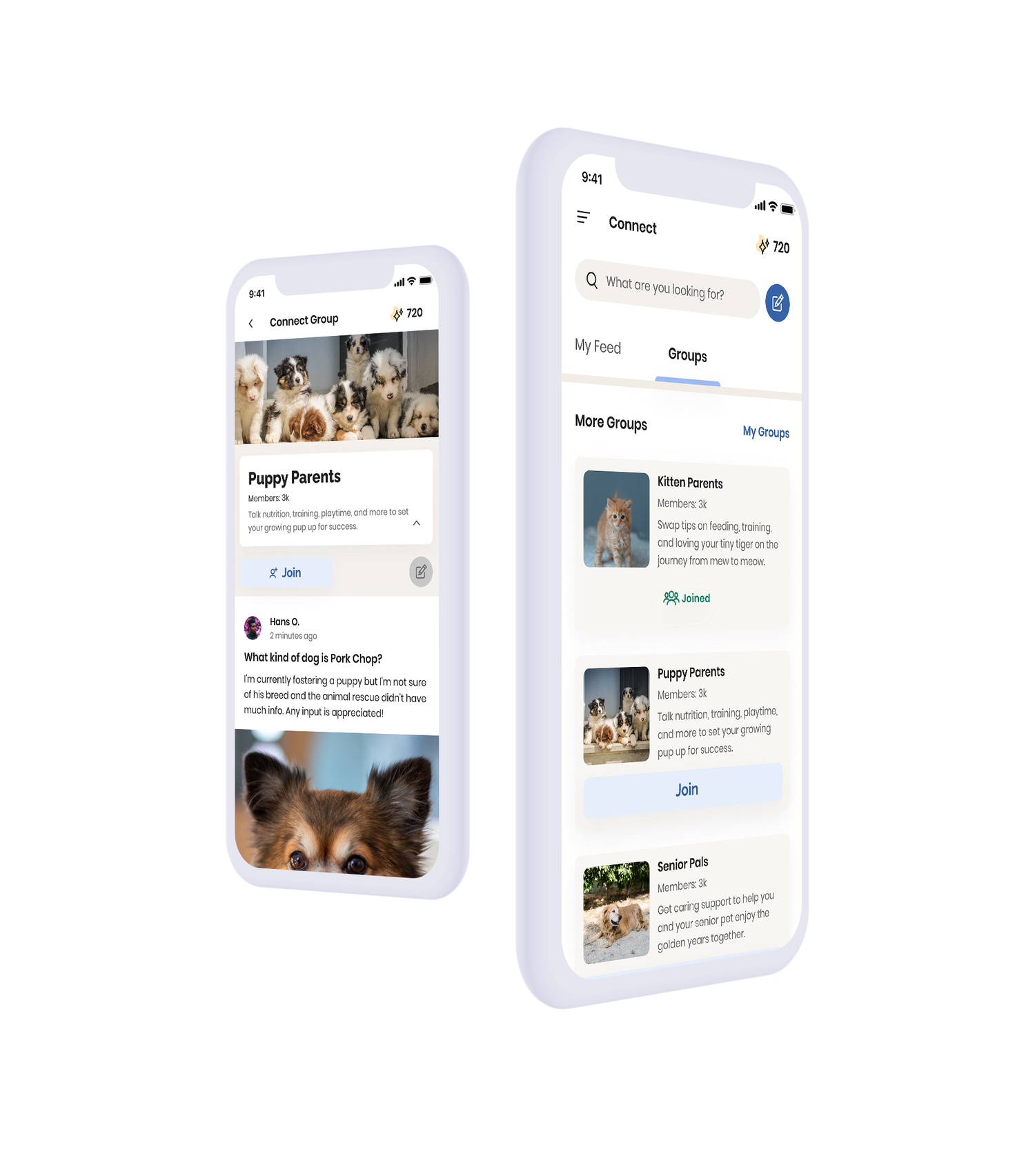
I also leaned into the companion principle, adding lightweight social proof and group moments that made the app feel like part of caring for a pet rather than a checkout step. Each change reinforced the loop: see a reason to earn, earn easily, feel rewarded, return.
A design system and a team that could keep up.
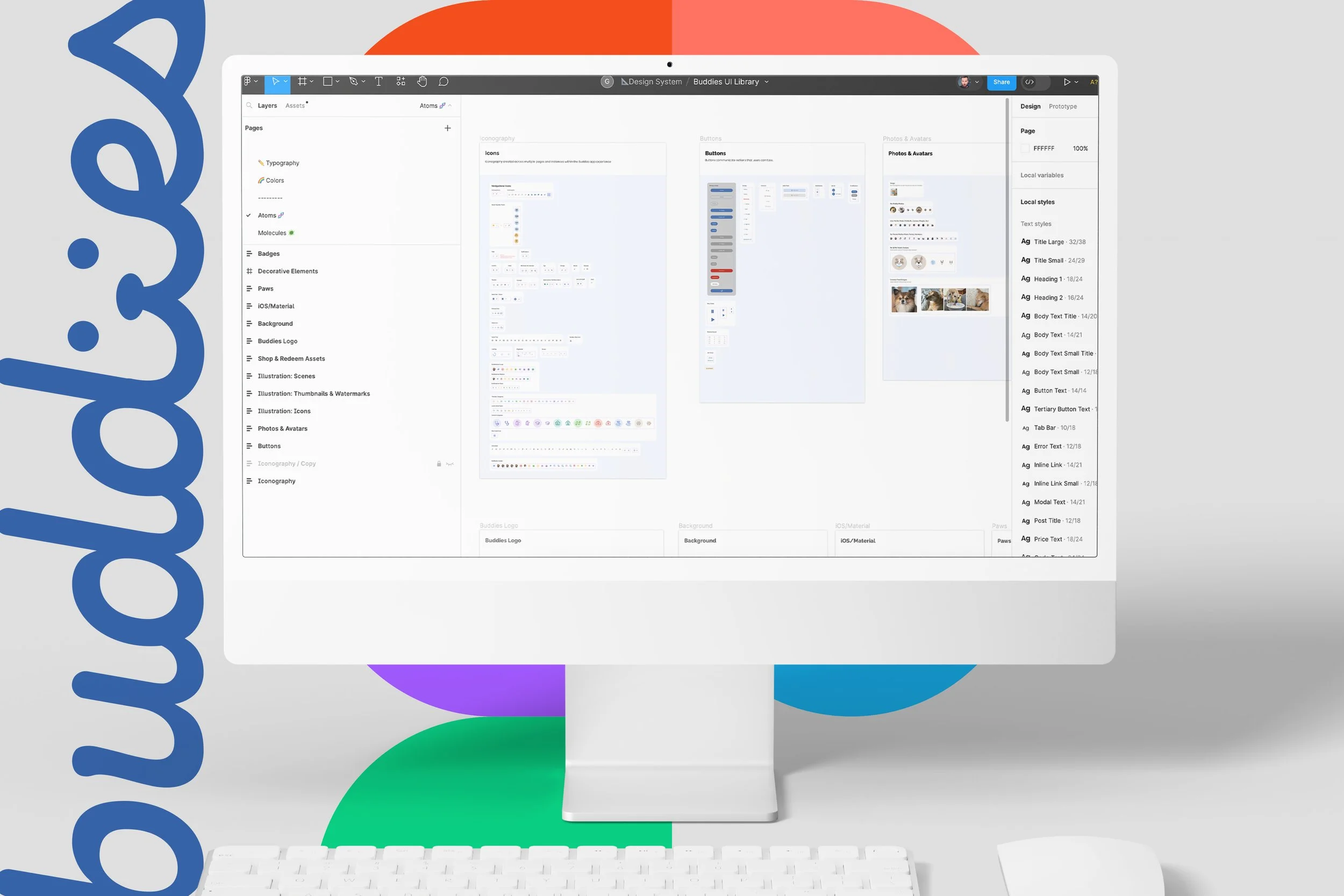
Sustained growth needed more than good screens. I built the Buddies design system in Figma, a documented component library shared across iOS and Android, so the four of us could design consistently and hand off cleanly. Standardizing components and specs cut design-to-engineering handoff time by roughly 50%.
As the first in-house Design Lead, I also set how the team worked: running design critiques, pairing designers to features, and building a shared review rhythm with the PM and engineering. The system was as much about people and process as it was about tokens and components.
Loved by users, recognized by the industry.
The redesign moved the numbers that mattered and the ones leadership felt. Active users grew from 210K to 810K. Store ratings climbed from 4.7 to 4.9 on iOS and 4.8 on Android. Thirty-day retention rose 73%, and active users became 2.3x more likely to return month over month.
3.9xGrowth in active users
2.3xMore likely to stay monthly active
73%Higher 30-day retention
40%Fewer support tickets
The work was recognized beyond the team, earning a 2023 Gold Stevie Award and recognition from Loyalty360 for customer loyalty design.
What I took from it.
01
Discovery beats generosity
The biggest unlock was not a better reward, it was making the existing one findable. Solve for awareness before adding more.
02
The right friction helps
An extra confirm step raised completion. Simplicity is about reducing risk and doubt, not just taps.
03
Build the team into the system
A component library plus a critique rhythm let four designers ship like a larger team, and kept quality even as scope grew.